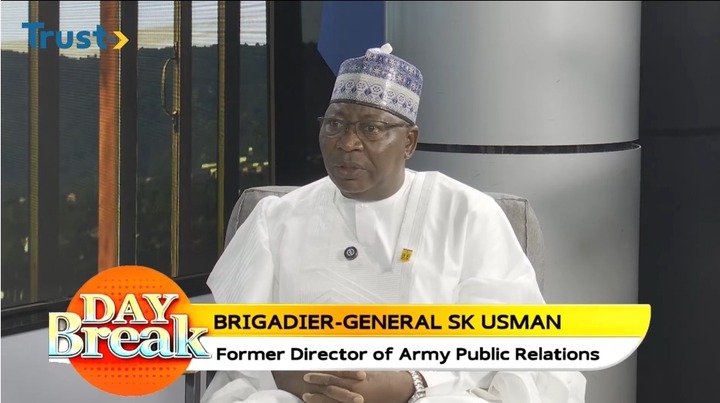
Brigadier-General SK Usman (retd), former Director of Army Public Relations, has reflected on the difficult conditions he faced as a young soldier, saying the hardships he experienced never pushed him toward crime and emphasizing that discipline and personal values remained the foundation of his military career.
Usman made the remarks during an interview published on the official Trust TV YouTube channel on Friday, July 24, 2026, while discussing soldiers’ welfare and concerns about misconduct within the military.
Recalling his early years in the Nigerian Army, the retired general said he enlisted as a very young soldier, barely in his teenage years, and was required to pay for his own accommodation.
According to him, the room was constructed almost entirely from zinc sheets, with zinc forming the walls and roof. The structure was so small that he had to bend down each time he entered.
“When I joined the army, I joined as a young soldier, barely a teenager,” Usman said. “I had to pay for my accommodation. It was made of zinc on the left, right, front, back, and even the roof. In fact, whenever I entered my room, I had to bend down. Did I go into crime? No.”
Usman said his experience demonstrated that hardship alone should not be used to justify criminal conduct. While acknowledging that economic difficulties can be severe, he argued that many Nigerians face challenging circumstances without resorting to unlawful activities.
He maintained that personal character, discipline, and upbringing play significant roles in determining how individuals respond to adversity.
The retired military officer also stressed the importance of improving the welfare of serving personnel, noting that the sacrifices made by members of the armed forces should be matched with continued government support.
According to Usman, authorities should regularly review soldiers’ salaries and working conditions to reflect current economic realities. He said housing, healthcare, and other social welfare benefits should also receive continuous attention to improve the quality of life of military personnel.
He emphasized that better welfare is necessary not only to support soldiers and their families but also to recognize the demanding nature of military service.
However, Usman insisted that improvements in welfare should not diminish the expectation that military personnel maintain high ethical standards. He argued that integrity remains a personal responsibility regardless of financial or living conditions.
In his concluding remarks, the retired brigadier-general reiterated that although government should continue strengthening welfare packages for soldiers, individuals must resist criminal behavior and uphold discipline even when confronted with difficult economic circumstances and challenging living conditions.
His comments came as part of a broader discussion on soldiers’ welfare, accountability, and the factors that influence misconduct, with Usman maintaining that both institutional support and personal responsibility are essential to preserving professionalism within the Nigerian Army.