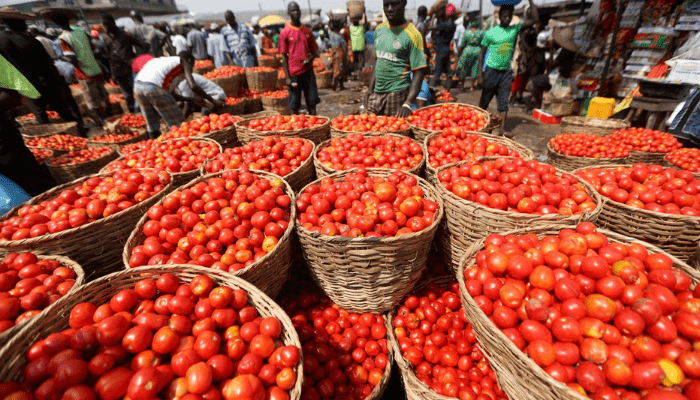
Nigeria could experience shortages of rice, tomatoes and other staple foods within the next three months unless urgent measures are taken to address declining agricultural production, insecurity and supply chain challenges, the Organisation for Technology Advancement of Cold Chain in West Africa (OTACCWA) has warned.
The warning was issued by the President of OTACCWA, Mr. Alexander Isong, during an interview with the News Agency of Nigeria (NAN) on Sunday in Lagos.
Isong, who also serves as the Nigeria Country Director of the World Agriculture Forum, said the projected shortages could further worsen food inflation and increase the financial burden on households already struggling with rising food prices.
According to him, rice production is expected to decline by six percent to approximately 8.3 million tonnes, while the total area under cultivation is projected to decrease by seven percent to about 4.2 million hectares.
“Rice is the big one. Production is projected to drop six per cent to 8.3 million tonnes. The area planted is down seven per cent to 4.2 million hectares. The United States Department of Agriculture confirms a five per cent decrease year-on-year. Tomatoes are another headache,” Isong said.
He explained that reduced cultivation and lower production levels are likely to significantly affect food availability in markets across the country over the coming months.
Isong also warned that the shortage of tomatoes could continue until the late harvest season expected in October.
Beyond rice and tomatoes, he said other staple crops, including maize, sorghum and millet, could also experience supply constraints due to reduced planting recorded during the 2025 farming season.
According to him, increasing transportation costs have become another major factor driving food prices upward.
“Moving a tonne of grain from Kano to Lagos now costs N70,000. It used to be N45,000. On some routes, transport fares have doubled or even tripled. Energy is another killer,” he said.
He added that onions and peppers are already experiencing limited supply in major producing areas, resulting in sharp increases in market prices.
The OTACCWA president also noted that Nigeria is expected to remain heavily dependent on wheat imports, with about 7.2 million tonnes projected to be imported to meet domestic demand.
Isong attributed the country’s food supply challenges to several factors, including insecurity in farming communities, declining agricultural production, high transportation costs, inadequate storage facilities and disruptions within the food supply chain.
According to him, persistent insecurity in major food-producing areas, particularly in northern Nigeria, has displaced thousands of farmers, limiting access to farmland and reducing agricultural output.
“Insecurity in major food-producing areas must be addressed. Farmers cannot produce enough food if they are unable to access their farms safely,” he said.
He stressed that strengthening security across key agricultural belts would be essential to restoring production and stabilizing food supplies nationwide.
Isong also called for urgent efforts to reduce transportation and logistics costs, noting that these expenses now account for a significant proportion of food prices paid by consumers.
He urged the government to improve rural road infrastructure, expand rail freight services for agricultural produce and promote more efficient logistics systems to reduce the cost of transporting food from farms to urban markets.
According to him, although Nigeria recorded stronger agricultural Gross Domestic Product (GDP) growth during the first quarter of 2026, the improvement has not translated into increased food availability for consumers.
He explained that production gains are being undermined by post-harvest losses, reduced cultivation and insecurity affecting farming communities.
“Production gains are being offset by post-harvest losses, reduced planting and insecurity in producing communities. The result is that consumers may continue to experience supply shortages and renewed price increases for key staples,” he said.
To prevent shortages of rice, tomatoes, peppers, onions and other essential food items over the next three months, Isong called for coordinated action involving the Federal Government, state governments, the private sector and development partners.
“This is not a problem that can be solved by one institution alone,” he said.
He identified reducing post-harvest losses as one of the country’s most urgent priorities, noting that Nigeria still loses between 30 and 50 percent of its perishable agricultural produce before it reaches consumers.
According to Isong, investing in cold chain infrastructure and modern storage facilities would significantly improve food preservation and reduce waste across the agricultural value chain.
He also urged authorities to accelerate the distribution of improved seeds, fertilizers, irrigation support and affordable financing ahead of the 2026/2027 planting season.
“Since rice production is projected to decline because of reduced planting, every effort must encourage increased cultivation during the next production cycle,” he said.
The OTACCWA president further emphasized the importance of restoring security in farming communities to enable farmers to return safely to their fields and increase production.
He reiterated his call for lower logistics costs through improved rural road networks, expanded rail transportation and more efficient food distribution systems.
Isong also encouraged state governments to invest in aggregation centers, cold storage facilities, food processing plants and produce markets located close to farming communities to minimize losses after harvest.
In addition, he appealed to private investors to expand investment in cold chain infrastructure, food processing facilities and contract farming initiatives supported by affordable financing.
He advocated stronger collaboration among federal and state governments, commodity associations, farmer cooperatives, logistics providers and development partners to monitor food availability and respond quickly to emerging supply challenges.
“Nigeria produces enough food in many sectors, but too much of it is lost before it reaches consumers. If we reduce post-harvest losses, improve logistics, secure farming communities and support farmers, we can reduce shortages,” Isong said.
His warning comes amid continuing concerns over food inflation, rising transportation costs and the impact of insecurity on agricultural production, with experts increasingly calling for coordinated policy measures to strengthen Nigeria’s food security and stabilize the supply of essential commodities.