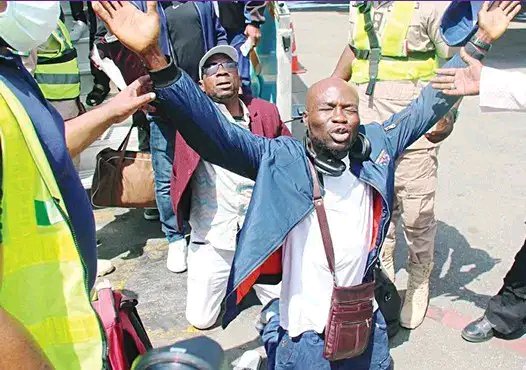
For the 258 Nigerians who returned home aboard an Air Peace flight under Federal Government’s evacuation programme, Thursday, it was a moment of relief after years of enduring xenophobic attacks and discrimination in South Africa.
Though exhausted from the nearly six hours journey, their faces beamed with victorious smiles as they stepped onto Nigerian soil. Some knelt. Some raised their hands in the air as though waving goodbye to the past. Some walked with swagger, as if a yoke had been broken.
For many, their voices, filled with ecstasy, carried a mixture of gratitude, excitement and hope for a fresh start.
For instance, Wasiu, who lived in South Africa for about 11 years, said life as a Nigerian migrant was fraught with discrimination and insecurity, adding that in South Africa, nationality often determined how one was treated.
Ordeal
According to him, the reason for that was that “if anything happens, once they hear that you are from Nigeria, you are wrong. Even when you are right, they will prove you wrong. We explained these things to Nigerian government, which usually promised to sort them out. However, nothing changed.
“In South Africa, if you are just passing on the street, they can call you and say: ‘Come here, can I have your phone?’ If you try to argue with them, they can just take out a knife and stab you to death. When the police come, they do nothing. They treat us like animals.
“Two weeks ago, I was just sitting with my friend when I saw the police coming. Having sighted them, I moved away, but they arrested my friend, who stayed behind. We had to pay 2,500 rand to secure his release for doing nothing. We just make money, and the police collect it.”
Reason for migrating
Asked why he migrated to South Africa, he said: “Nigerians who travel abroad do not go there for fun. They look at the money that can be earned abroad and think that if they earn a certain amount in foreign currency monthly and send it home, it is a lot. They can do something tangible with it, like building a house. Those were some of the things I considered that motivated me to go there.”
Asked what he did in South Africa, he said: “I am a mechanic. I fix cars, but they do not even give us the freedom to do anything. So, I am surprised when they say we are taking their jobs. You will not see Nigerians working in their shops. You only see foreigners working on the streets. Some use motorbikes to do food deliveries. South Africans also have the opportunity to do these things, but they do not want to work. They do not even like to work.”
Hope
Asked about his next steps, he said: “I have a lot of hope because, number one, I am not a lazy man; I can work. I believe that as long as I am in my country, I am protected and nothing bad will happen to me. However, I need to relax my mind, stay with my family, talk to them and just feel at home first. I need to delete the memory of South Africa. So, I will now ask myself this: what can I do? Then take steps to achieve it.”
Hellish
Wasiu is not alone in this. Adediran Ayodeji, an Oyo State indigene, lamented the xenophobic attacks, saying they made life hellish for black foreigners.
Military
Ayodeji, who said he was back in the country to join the military and fight terrorists, said he would also like to further his education in Nigeria, as he could not continue in South Africa.
He said: “I was in South Africa for 13 years. I wanted to further my education in South Africa. It was an undergraduate programme. I got a few jobs there. I was a chef, and I also did digital marketing. I am happy to be back home. Now, I would also like to further my education and serve Nigeria.”
Jealous
Meanwhile, Amao described South Africans as very jealous, saying they do not like to see foreigners.
Attacks
“A friend of mine lost one of his eyes. It was the white man he worked for as a security guard who gave him some money and took him to the hospital so that a glass eye could be fitted before bringing him back home.
“I have not worked for the past two years because my leg is broken. I was returning from work when I was almost attacked and jumped a fence, leading to the injury. The cost of the operation is expensive, so I have been managing the leg. I am joyful to return. Now that I am back in the country, I have to start from scratch. I have to join the struggle to make Nigeria great.”
Joy, who appeared exhausted, was carrying her 10 months old baby on her back, while her two years old child stood beside her.
She said: “You cannot find proper work because they believe that all their jobs are for them. If you manage to create one for yourself, they will come there to disturb you or loot your stuff.”
She said that rather than coming back, many Nigerians have chosen to stay because “they think that they will come back home and have to start afresh, and some of them do not have the money to return and start something.”