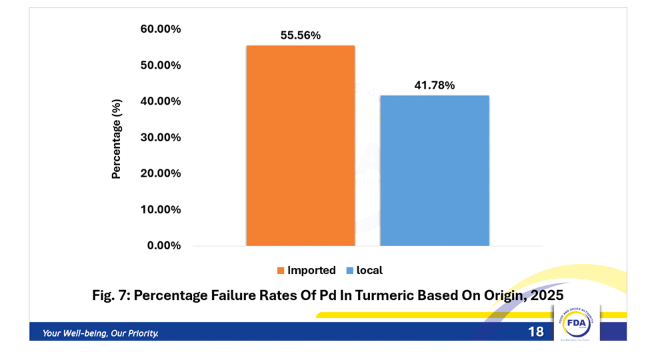
Imported turmeric products sold on the local market – according to a 2025 report by the Food and Drugs Board Authority – contains higher levels of lead contamination than locally sourced products, which raises concerns about consumer protection and import controls.
According to the study, 55.56 percent of imported turmeric samples failed lead safety standards as compared with 41.78 percent of locally sourced turmeric.
The findings come from an analysis of 392 turmeric samples collected from open markets, retail shops, supermarkets and malls across several regions of Ghana.
Widespread contamination
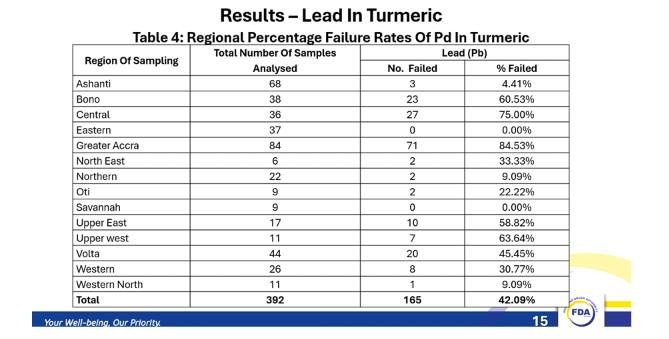
Overall, the report revealed that 42.09 percent of all turmeric samples tested contained unsafe levels of lead, with 165 out of 392 samples failing.
Lead is a toxic heavy metal commonly used in batteries, paints, pipes and industrial products. Exposure to high levels of lead can cause serious health problems such as damage to the brain, nervous system and kidneys and developmental problems in children.
Greater-Accra records highest results
According to the findings, Greater-Accra recorded the highest level of lead contamination in turmeric where 71 out of 84 samples from Greater-Accra failed, representing an alarming 84.53 percent failure rate.
Other highly affected regions include: Central Region with 75.00%, Upper West – 63.64%, Bono – 60.53%, Upper East – 58.82% and Volta – 45.45%
However, the Eastern and Savannah Regions recorded zero contamination cases in the samples tested.
Supermarkets record highest contamination
The study also revealed high contamination levels in products sold through formal retail channels. Supermarkets and malls recorded a 91.67 percent failure rate, the highest among all retail categories -which according to the report is surprising due to the perception that packaged products sold in supermarkets are safer than those sold in traditional markets.
The report further disclosed a 47.79 percent failure in retail shops and 37.45 percent failure in open markets.
Branded products perform poorly
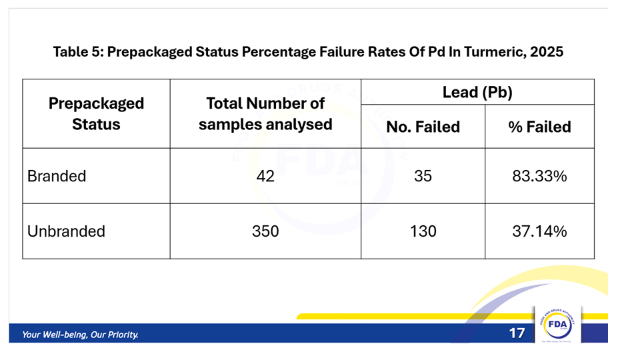
The result further showed that 83.33 percent of branded turmeric failed, compared with 37.14 percent of unbranded turmeric
Of 42 branded samples tested, 35 failed safety standards while 130 out of 350 unbranded also failed.
Economic and industry impact
The findings raise significant concerns for Ghana’s spice and food industry, particularly businesses involved in the importation, processing and sale of turmeric products. Importers and retailers may face stricter regulatory scrutiny, increased testing requirements and growing pressure to ensure compliance with food safety standards. The contamination concerns could also weaken consumer confidence in imported turmeric products.
The study further carries implications for trade and market competitiveness. Rising concerns over lead contamination in turmeric may affect the ability of businesses to access international markets, where food safety regulations are strictly enforced. Importers and distributors could also face increased costs linked to product screening, certification and quality assurance measures.
Actions being taken
For the FDA these findings have prompted urgent calls for regulatory action, with an expectation to initiate an immediate recall of all implicated and registered food products currently on the market.
In response to the elevated contamination levels, FDA said registration requirements for turmeric have been revised to include mandatory testing for lead.
FDA has also intensified nationwide sensitisation programmes to raise awareness about the report’s findings and health risks associated with the consumption of unregulated products.
Furthermore, investigations will expectedly be undertaken to identify the sources of contamination and guide the implementation of targetted regulatory interventions aimed at safeguarding public health and safety.
Additionally, efforts are being stepped up to strengthen border controls and market surveillance – particularly for high-risk food products – to prevent further exposure and ensure compliance with safety standards.