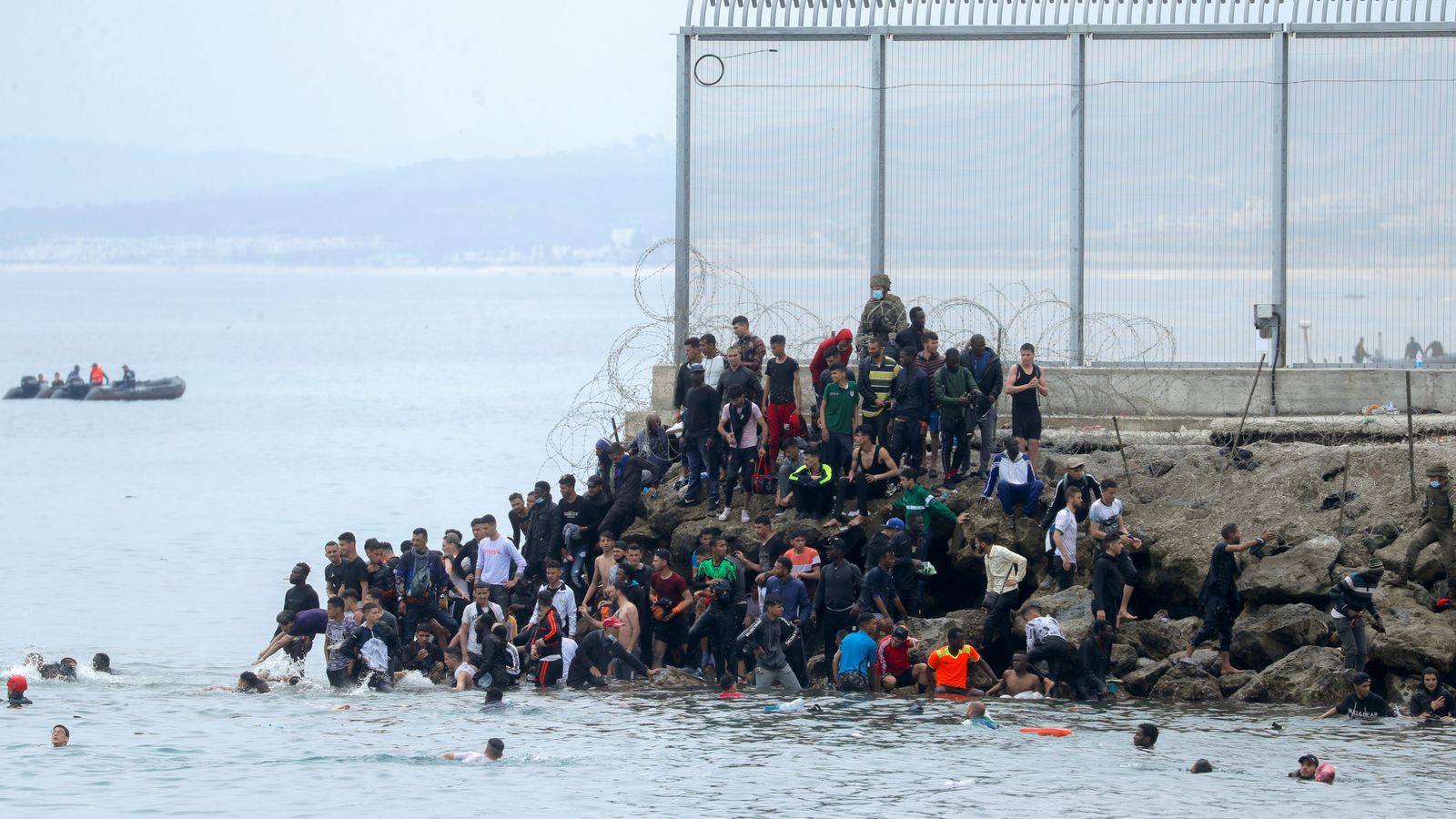
At least 60 people have died attempting to reach the Spanish enclave of Ceuta after up to 60,000 migrants crossed into the territory from Morocco in just 24 hours, triggering a humanitarian and political crisis in Spain.
Spanish Prime Minister Pedro Sánchez described the mass influx as “a violation of Spain’s territorial integrity” as the surge overwhelmed the enclave, which has a population of about 85,000 people. Sánchez, who visited Ceuta on Friday, July 31, said the Spanish government would use all available resources to guarantee the safety of residents.

He blamed the unprecedented crossings on human trafficking networks, which he said had taken advantage of a recent Spanish Supreme Court ruling preventing the immediate return of migrants intercepted at sea while attempting to reach Ceuta or Spain’s other North African enclave, Melilla.
“That has spread like wildfire during these last few hours through the networks of mafias that traffic in human beings and has produced an avalanche of the characteristics and dimension that we experienced yesterday,” Sánchez said.
The prime minister announced plans to establish a temporary reception centre to facilitate the documentation, registration, triage and expedited removal of migrants with no legal basis to remain in Spain. He also said the government would install a visible barrier of buoys near the breakwater at Ceuta’s Tarajal beach to clearly mark the border while complying with the Supreme Court’s ruling.
Spain’s Interior Ministry, which has deployed additional police officers and soldiers to the enclave, said more than 37,500 migrants had voluntarily crossed back into Morocco by Friday afternoon. The developments prompted strong reactions across Europe.
Italy announced it would suspend the Schengen border-free travel arrangements with Spain for one month in response to the migration surge. Although Italy does not share a land border with Spain, the measure means travellers moving by air or sea between the two countries will be required to present passports. Italy’s Interior Ministry also said it had agreed with France to strengthen controls along the Franco-Italian border to prevent undocumented migrants from crossing.
The announcement drew a sharp response from Madrid after Italian Foreign Minister Antonio Tajani blamed Spain’s migrant regularisation programme for encouraging human trafficking. Spain’s Foreign Minister, José Manuel Albares, summoned Italy’s ambassador, describing Tajani’s comments as “unbecoming” and accusing Italy of engaging in “partisan demagoguery.”
The European Commission later clarified that Ceuta and Melilla operate under special Schengen rules that prevent migrants from moving freely into the rest of the border-free zone. EU Migration Commissioner Magnus Brunner described the situation in Ceuta as “unacceptable” and said he was in close contact with Spanish authorities.
Ireland also expressed support for Spain. Justice Minister Jim O’Callaghan said he had spoken with Spain’s Interior Minister Fernando Grande-Marlaska. “I expressed my solidarity and support to the Spanish Government as they deal with the situation in Ceuta,” O’Callaghan said in a post on X.
He added that, as part of Ireland’s Presidency of the Council of the European Union, he had requested an emergency meeting of the EU’s Integrated Political Crisis Response (IPCR) mechanism and a meeting of EU ambassadors. The latest influx far exceeds the previous mass crossing in May 2021, when around 10,000 migrants entered Ceuta over two days following a temporary relaxation of border controls by Morocco.
Moroccan government sources told Europa Press that criminal organisations were responsible for the latest crossings and insisted Rabat’s cooperation with Spain remained “exemplary.” Rachid Sbihi, head of a workers’ association representing Spain’s Guardia Civil officers, described the situation as “a serious humanitarian crisis.”
According to Sbihi, thousands of migrants, including unaccompanied children, have been left without shelter, sleeping in parks and on pavements while others wander the streets. “It’s chaotic,” he said.
He added that many of those who died drowned while attempting the crossing, while others were killed in a crush near the breakwater fence at Tarajal beach. Footage from the area showed large groups of migrants, including young men, women and children, making their way from the shoreline onto roads inside the Spanish enclave.