Ukraine said it reclaimed more of its territory than it lost during May, reversing a Russian trend of monthly net gains. The territorial shift comes amid a broader military push where Ukraine says its “lockdown” strategy is successfully disrupting frontline Russian supply lines.
“The ratio of liberated and lost territories is almost 100 square kilometres (40 square miles) in our favour,” wrote Ukrainian commander-in-chief Oleksandr Syrskii on his Telegram messaging channel.
Ukrainian defence news outlet Militarnyi estimated net gains slightly higher, at 120 square kilometers (46 square miles), citing sources within the military. Militarnyi said Russia seized 130 square kilometers (50 square miles) and lost 250 square kilometers (100 square miles) during the month.
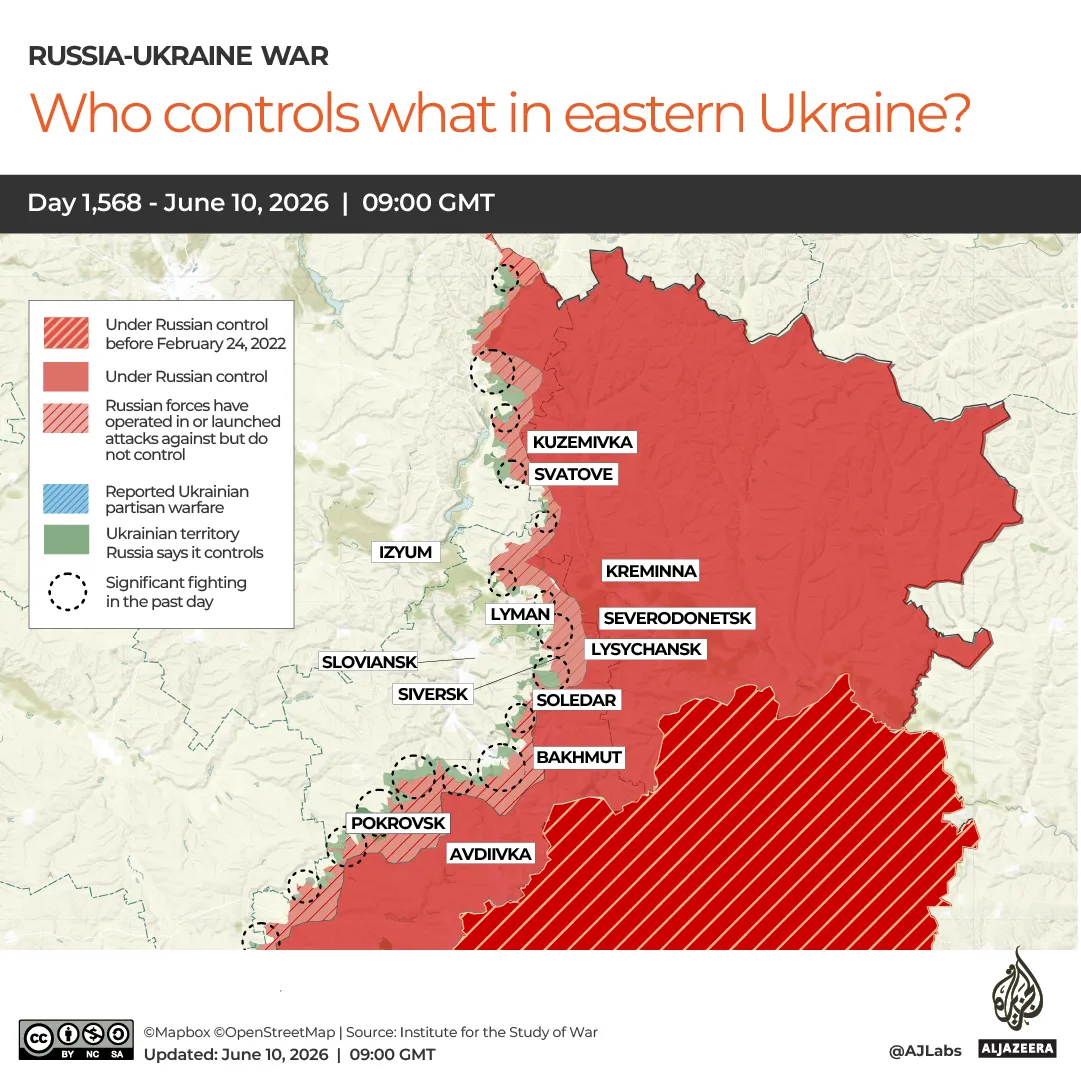
Meanwhile, the Washington-based Institute for the Study of War (ISW) assessed Ukrainian gains higher still, stating that Russia had seized or infiltrated 40 square kilometers (15 square miles) in May but lost control of about 280 square kilometers (108 square miles).
The ISW’s assessments suggest Ukrainian gains are growing, following a similar trend in April when it estimated Moscow’s gains at 28 square kilometers (11 square miles) of Ukrainian land against losses of 116 square kilometers (45 square miles). Syrskii noted that Ukraine has reclaimed a total of 600 square kilometers (230 square miles) during the first five months of 2026.
However, Russia found success on one part of the front. Ukrainian military observer Kostyantyn Mashovets reported that Russian forces had advanced into eastern Konstiantynivka, the southernmost of a “fortress belt” of four cities in the eastern region of Donetsk. Russian forces first infiltrated parts of the city last October and now hold about 13 percent of it, according to the ISW.
Capturing the remaining one-fifth of Donetsk remains a stated priority for Russian President Vladimir Putin, though multiple set deadlines to achieve this have been missed.
Amid the territorial shifts, potential lines of communication have emerged. Although Putin publicly rejected a call from Ukrainian President Volodymyr Zelenskyy for direct talks on June 5, Zelenskyy stated he met with Russian oligarch Roman Abramovich, who has been acting as an intermediary for the Kremlin.
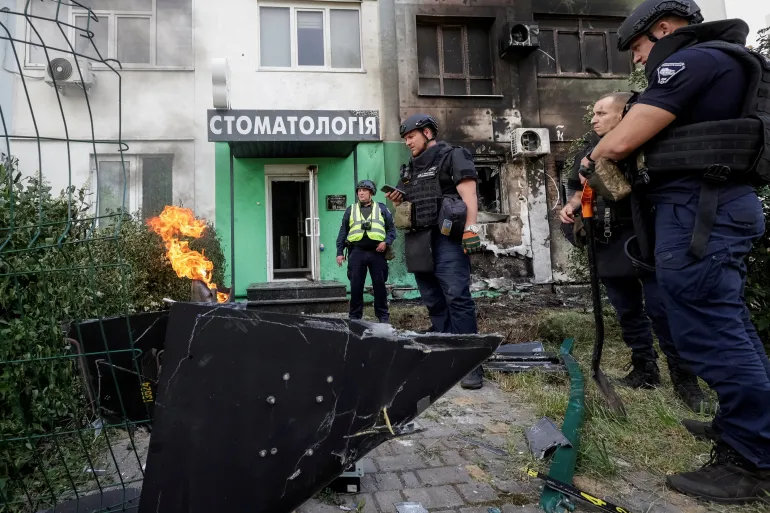
Ukraine attributes its recent battlefield achievements to a targeted strategy of disrupting Russian supply lines by striking fuel and ammunition in warehouses and in transit.
“The logistical lockdown is working,” said Ukrainian Defence Minister Mykhailo Fedorov. “The number of hits on enemy targets at a distance of over 50km (30 miles) from the (frontline) has doubled,” he noted, comparing May to April. Syrskii put the May total at almost 2,000 strikes.
The effects of this long-range interdiction strategy have begun to build up significantly in the south. Weeks of attacks in the southern regions of Kherson and Zaporizhia reduced Russian military traffic by more than 70 percent along the M-14 motorway, the main east-west route, according to Robert Brovdi, commander of Ukraine’s Unmanned Systems Forces. On June 7, regional authorities prohibited traffic along the M-14 highway altogether.
The closure of the M-14 forced Russian planners to reroute supplies via Crimea using the E105 and E97 highways. However, Ukraine subsequently struck a bridge carrying the E105 over the Chonhar Strait, leaving only the E97 passable. Soon after, as a convoy of roughly 50 Russian fuel and ammunition trucks rerouted to the E97, Ukrainian forces ambushed and destroyed a portion of them at Armyansk, commander Dmitry Filatov told Suspilne Radio.
Filatov explained that this operation would not have been possible if other units had not struck at Mariupol and the road to Berdyansk. He noted that those mainland disruptions are precisely what forced the units stationed in the Hulyaipil direction to be supplied via Crimea instead of the usual Mariupol highways.
Civilians and military infrastructure in Crimea have faced severe fuel shortages as a result of the logistics strikes, worsening dramatically over the week. On June 7, Sevastopol occupation governor Mikhail Razvozhaev rationed fuel to 20 litres per car per day, later tightening the restriction to 20 litres per week.
The supply crunch is reportedly forcing troop movements. The Ukrainian underground group Atesh, which operates in Crimea, reported that Russian units were abandoning their positions on the Kinburn Spit due to depleted food and fuel reserves.
Brovdi told Reuters that the ultimate goal is to create conditions under which it will be extremely difficult for military personnel and defence industry workers to remain in Crimea, or to use any of the transit routes leading to the temporarily occupied territories.
While Russia’s air force continues to command the skies over eastern Ukraine using large aerial ordnance, Ukraine’s figures suggest its drone production and deployment have provided an effective counterweight. Ukrainian short- and medium-range drones hit 180,000 targets in May, a 12.7 percent increase over April.
Ukrainian air defenses are also reporting higher success rates against Russian Shahed loitering munitions using specialized interceptor drones. Although Russia launched 25 percent more Shaheds in May compared to April, interceptions increased by 50 percent to roughly 4,000, according to Fedorov.
The defense ministry expects further efficiency once a new generation of interceptor drones that automates 95 percent of the interception process enters full production.
Beyond these mid-range operations, Ukraine has sustained a long-range strike campaign targeting Russian refineries, oil depots, and offloading terminals deep within Russian territory, impacting domestic refining capacity and export revenues.