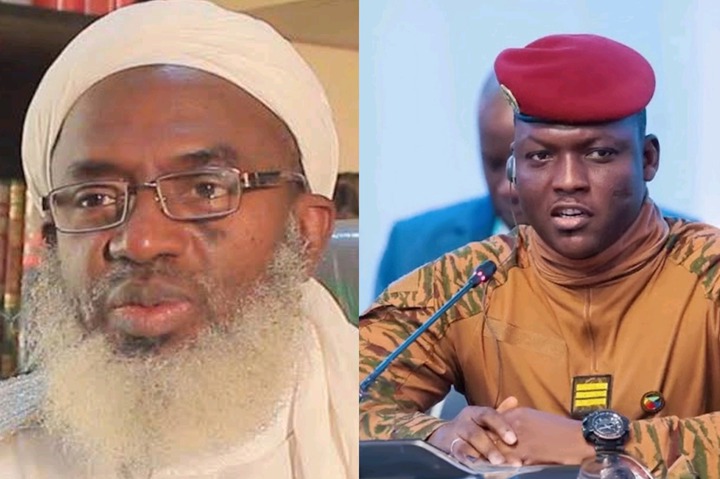
Sheikh Ahmad Gumi has criticized Burkina Faso’s military leader, Captain Ibrahim Traoré, following the latter’s declaration that Sharia law would never be introduced in the country, arguing that the stance could have unintended security consequences.
According to a Facebook post published by Gumi on July 25, 2026, the Islamic cleric described Traoré as an inexperienced leader who does not fully understand the complex religious, social and geopolitical issues involved in governing a nation.
Gumi’s comments came in response to Traoré’s recent nationwide broadcast in which the Burkinabè leader reaffirmed that Burkina Faso would not adopt Sharia law, despite identifying himself as a Muslim.
During the broadcast, Traoré stressed that every citizen has the constitutional right to practice their religion freely and insisted that his administration would not permit the introduction of Sharia law in the country.
He also criticized Burkinabè students studying Sharia law in Saudi Arabia, arguing that they would have been better served by acquiring technological and technical skills that could contribute to Burkina Faso’s development.
Traoré further warned those students to remain abroad, stating that they would not be allowed to return to the country.
Reacting to those remarks, Gumi questioned Traoré’s preparedness for national leadership, saying the military ruler lacked the experience needed to appreciate the broader implications of his position.
The Islamic scholar noted that Traoré, whom he identified as 38 years old, has little experience outside his military background.
According to Gumi, the Burkinabè leader is “too inexperienced” to fully understand the society he governs and the complexities of contemporary international politics.
He argued that decisions on sensitive issues such as religion should be approached with caution because of their potential impact on national security and social stability.
Gumi further claimed that Traoré’s rejection of Sharia law could inadvertently strengthen extremist groups by providing them with a narrative to attract new recruits.
According to the cleric, the military leader’s comments had effectively handed extremist organizations a powerful recruitment message that could encourage more people to join their ranks.
The remarks have added to ongoing discussions about the relationship between religion, governance and security in Burkina Faso, a country that continues to face significant security challenges linked to extremist violence.
While Traoré has maintained that his administration is committed to protecting religious freedom and preserving the country’s secular framework, Gumi believes the government’s approach to the issue could have wider consequences if not carefully managed.
The exchange has generated fresh debate over the role of religion in governance, as well as the potential security implications of policies and public statements made by political leaders in countries confronting insurgency and ideological extremism.